The 6-Week Pilates Body Method: Tone, Lengthen, and Define at Home
Pilates is the fastest-growing fitness search term of 2026 for a reason that goes beyond trend. The exercise science underpinning it is genuinely effective: deep core activation, controlled eccentric loading, proprioceptive challenge, and high-frequency low-load movement create a specific type of body composition change that high-intensity training cannot replicate. The result — often described as the "Pilates body" — is characterised by improved posture, visible core definition, lengthened musculature, and a reduction in the postural imbalances that accumulate from sedentary work patterns.
This 6-week Pilates body method programme is not a reproduction of any existing guide or instructor's system. It is an original FormForge programme built on Pilates exercise science principles: neutral spine mechanics, core-first movement sequencing, breath synchronisation with exercise, and the controlled tempo that distinguishes genuine Pilates-method training from regular floor exercise.
No studio, no reformer, no equipment barrier. A mat and a resistance band are all that is required.
The Pilates Principles Applied to This Programme
Six exercise science principles from the Pilates method are embedded into every session structure:
| Principle | How It Is Applied in This Programme |
|---|---|
| Centring | Every exercise begins with a 3-second core activation breath before the first rep. No exceptions. |
| Concentration | Sessions are 35–45 minutes only. No distractions. Every rep is deliberate. |
| Control | All movements use a minimum 2-second eccentric. Fast reps are not permitted in this programme. |
| Precision | Exercise descriptions include specific body positioning cues. These are not optional detail — they define the exercise. |
| Breath | Exhale on the effort (the lift or push phase); inhale on the return. Stated for each exercise. |
| Flow | Sessions move between exercises with minimal rest. Transitions are themselves part of the training. |
Equipment
Weeks 1–4 require only a mat with adequate cushioning. Weeks 5–6 introduce light resistance band loops to add external load to core and glute movements, which extends progressive overload without requiring weights.
🟡 Resistance Band Loop Set — Light / Medium / Heavy (paid link) — the light band is used throughout Weeks 5 and 6 for banded Pilates bridges, clamshells, and side-lying abduction sequences. The medium band is optional for advanced variations in the final week. 🦵 Ankle Weights Set 1kg–2kg (paid link) — introduced in Week 4 for leg series work. The 1kg weight per ankle is the appropriate starting load for Pilates-method single-leg movements. The additional resistance meaningfully increases the toning stimulus of the leg series without compromising the controlled tempo.The Foundational Breath and Activation Technique
This technique is performed before every exercise in the programme. It takes 5 seconds and fundamentally changes which muscles are recruited. Do not skip it.
- Lie on your back (or sit upright for standing movements) in neutral spine — a small natural curve in the lower back, not flattened to the floor.
- Place hands lightly on the lower abdomen, below the navel.
- Breathe in through the nose, allowing the ribcage to expand laterally (sideways, not upward).
- As you exhale through pursed lips, draw the lower abdomen gently inward and upward — as if pulling the navel toward the spine. You should feel the deep muscles engage under your hands. This is transverse abdominis activation.
- Maintain this activation throughout the set. Breathe in and out through the ribcage without releasing the deep engagement.
The 6-Week Programme — All Exercises, Sessions, and Progressions
📅 Phase 1 — Weeks 1 & 2: Core Foundation and Postural Reset
4 sessions per week. 45–50 min sessions. Slow controlled tempo throughout. Minimal rest between exercises (15–20 sec transition).
SESSION A — Core and Posterior Chain (Mon & Thu)
Begin each exercise with the foundational breath and activation.
- Imprint and Release — 3 × 8 reps (rock pelvis between posterior tilt and neutral, 3 sec per direction, re-establishes lumbar awareness)
- Pelvic Curl — 3 × 10 reps (roll spine up one vertebra at a time, exhale on the way up, 4-sec ascent, 4-sec descent)
- Single-Leg Tabletop Hover — 3 × 8 each side (from crook lying, float one leg to 90 degrees at hip and knee, hold 3 sec, lower — lower back stays imprinted)
- Double-Leg Tabletop Hold — 3 × 10-sec holds (both legs at tabletop, maintain neutral pelvis, breathe in and out 3 times per hold)
- Chest Lift — 3 × 10 reps (from crook lying, curl upper spine off floor as one unit, exhale at top, keep chin off chest)
- Prone Swimming Prep — 3 × 8 reps each side (on stomach, extend opposite arm and leg simultaneously, 2 sec hold — lengthens posterior chain)
- Child's Pose — 3 × 30-sec holds (hip-width knees, arms extended, full spinal decompression between core sets)
SESSION B — Leg Series and Flexibility (Tue & Fri)
- Side-Lying Leg Lift — 3 × 15 each side (2 sec up, 2 sec down, body in one straight line, do not roll forward)
- Side-Lying Front-to-Back Swing — 3 × 10 each side (controlled arc, hip flexion and extension in sagittal plane)
- Side-Lying Inner Thigh Lift — 3 × 15 each side (bottom leg lifts toward top leg — targets adductors)
- Clam — 3 × 15 each side (hips stacked, rotate top knee upward, do not roll pelvis)
- Supine Spine Twist — 3 × 8 each side (knees together at 90 degrees, lower both knees to one side, inhale — return on exhale)
- Spine Stretch Forward — 3 × 8 reps (seated, legs extended, reach forward on exhale, round through spine)
- Hip Flexor Stretch — 3 × 30 sec each side (low lunge, posterior pelvic tilt to release iliopsoas)
📅 Phase 2 — Weeks 3 & 4: Load and Lengthen
5 sessions per week. Add a Saturday 30-min flow session. Introduce ankle weights on leg series work (Week 4). Increase hold times on all isometric positions.
SESSION A — Deep Core and Hip Stability (Mon & Thu)
- Pelvic Curl with Single-Leg Extension — 4 × 10 reps (at top of bridge, extend one leg to tabletop, hold 2 sec, return before lowering)
- Hundred — 4 × full set (lie supine, legs at 45 degrees, arms reach long at sides, pump arms 5 cm up-down × 100 beats while breathing in 5 counts and out 5 counts. Modify: feet on floor if needed)
- Roll-Up — 4 × 8 reps (from supine, arms overhead, inhale — exhale to slowly roll up to seated, reaching toward feet, re-stack vertebra by vertebra back down)
- Single-Leg Circle — 4 × 8 each direction each leg (one leg extended to ceiling, trace circles keeping pelvis still)
- Side Kick Kneeling — 4 × 10 each side (kneeling on one knee, other leg extended at hip height, kick forward and back in controlled arc)
SESSION B — Full Body Integration (Tue & Fri)
- Swan Prep — 3 × 8 reps (prone, hands under shoulders, press into floor-length spine extension, hold 3 sec — works spinal extensors and gluteals)
- Single-Leg Kick — 3 × 10 each leg (prone up on forearms, kick heel to glute then extend — 2 pulses per rep)
- Side-Lying Leg Series with Ankle Weight (Week 4) — 3 × 15 each move: Lift / Front-Back / Inner Thigh / Small Circles
- Teaser Prep — 3 × 8 reps (supine, knees bent, extend arms to ceiling, curl to 45-degree seated balance — works entire anterior core)
- Saw — 3 × 8 reps each side (seated with legs wide, rotate and reach opposite hand past opposite foot on exhale)
- Thread the Needle — 3 × 8 each side (on all fours, thread one arm under the body — thoracic mobility)
SATURDAY — Pilates Flow (30 min)
Perform the following sequence continuously, transitioning with minimal rest. 2 full rounds:
- Cat-Cow × 10 reps → Spine Stretch Forward × 8 reps → Roll-Up × 6 reps → Hundred × 50 beats → Single-Leg Circle × 6 each → Side-Lying Leg Lift × 10 each side → Clam × 12 each side → Swan × 8 reps → Child's Pose 30 sec
📅 Phase 3 — Weeks 5 & 6: Banded Overload and Full Pilates Integration
5 sessions per week. Introduce light band on bridge and clamshell work. All hold times increase by 50% vs Phase 2.
SESSION A — Banded Core and Posterior Chain (Mon & Thu)
- Banded Pelvic Curl — 4 × 12 reps (light band above knees, maintain outward knee pressure throughout the bridge)
- Banded Clamshell — 4 × 20 each side (light band adds external rotation resistance)
- Banded Single-Leg Bridge — 4 × 15 each side (band above knees, non-working leg extended, hold 2 sec at top)
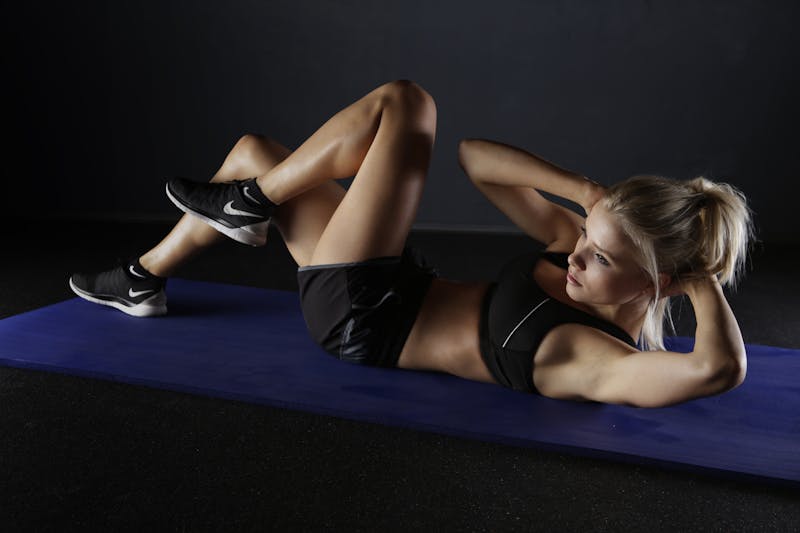
- Criss-Cross — 4 × 16 reps total (supine, hands behind head, alternate elbow-to-opposite-knee rotation with deliberate pause at peak rotation — exhale at each twist)
- Leg Pull Front — 3 × 8 reps each leg (high plank position, lift one leg 6 inches and hold 3 sec — entire posterior chain and core loaded simultaneously)
- Full Roll-Up — 4 × 10 reps (articulate through every vertebra; this movement becomes the benchmark for spinal mobility progress)
SESSION B — Advanced Leg Series and Upper Body (Tue & Fri)
- Side-Lying Star — 4 × 10 reps each side (stack legs, lift both simultaneously — requires hip abductor and oblique co-activation)
- Kneeling Side Kick — 4 × 12 each side (as Phase 2, add ankle weight for resistance)
- Push-Up with Pilates Tempo — 4 × 10 reps (4 sec descent, pause at bottom, press up in 1 sec — develops chest and anterior shoulder with deep core engaged)
- Plank Rotations — 4 × 8 each side (from high plank, rotate to side plank and stack feet, hold 3 sec)
- Hip Twist Prep — 3 × 8 each direction (seated, palms on floor behind you, legs together at 45 degrees, rotate legs side to side — maintains neutral spine throughout)
- Spine Twist — 4 × 10 each side (seated upright, arms in T, rotate — exhale on twist, lengthen spine before each rotation)
SATURDAY — Peak Flow (40 min)
3 complete rounds of the full Pilates sequence, adding the banded exercises in Rounds 2 and 3. Rest only in Child's Pose between rounds.
What Changes After 6 Weeks
The adaptations from a Pilates-method programme are specific and predictable. Understanding what to track keeps expectations realistic and reveals progress that scale weight cannot.
Posture: The combination of spinal articulation work (roll-ups, pelvic curls), posterior chain loading (swan, swimming), and deep core stabilisation directly addresses the forward-head, rounded-shoulder posture pattern that most women develop from desk work. By Week 4, most people notice this correction in photographs even before body composition changes are visible.
Core definition: The Hundred, Roll-Up, Criss-Cross, and Teaser Prep sequence targets the rectus abdominis, obliques, and transverse abdominis in sequence. Six weeks of this combined with adequate protein produces visible abdominal definition that is different in character from what HIIT produces — less bloated, more structural.
Flexibility: The hip flexor stretches, spine stretch forward, and saw movement appear in every phase of this programme. Progressive flexibility improvement is a guaranteed adaptation by Week 6 if these are performed with full exhale-driven range.
🥛 Whey Protein Isolate Vanilla 1kg (paid link) — the toning effect of Pilates-method training depends on sufficient protein to drive the lean muscle adaptation. 1.8g per kg of bodyweight daily is the target. 25g post-session in 200ml of water is the most efficient way to hit it.Recovery and Mobility Between Sessions
Pilates-method programmes are lower in acute soreness than high-intensity training, but the deep postural and stabiliser muscle activation can create unfamiliar fatigue — particularly in the mid-back, deep hip rotators, and inner thighs — that is distinct from the soreness produced by squats or deadlifts. Use the stretching strap on rest days to develop the hamstring and hip flexor range that the Phase 3 movements require.
🔹 Foam Roller — High Density Sports Recovery (paid link) — use on rest days for thoracic spine extension work. Lie with the roller perpendicular to the spine at mid-back, support your head, and gently extend over the roller across multiple positions. This directly counteracts the thoracic kyphosis that desk posture creates and dramatically improves Phase 3 movement quality.📊 Download the Free FormForge 6-Week Pilates Body Method Tracker
Session log, movement quality self-assessment, weekly flexibility benchmarks, and posture check-in guide. Track every session, measure every adaptation.
Get the Free Tracker →For more in the FormForge Summer 2026 series: [INTERNAL LINK: 6-Week Full Body Home Burn] | [INTERNAL LINK: 12-Week Bikini Body Conditioning Plan] | [INTERNAL LINK: 8-Week Tone at Home Recomp Program]
FormForge content is for educational purposes only. Consult a qualified fitness professional before beginning any new programme. As an Amazon Associate, FormForge earns from qualifying purchases. Links marked (paid link) are affiliate links. Amazon Associate tag: everydaytop03-21.
Comments
Post a Comment