How Long Does It Actually Take to Get More Flexible? Plus a Standalone Recovery Routine
"Stretch consistently and you'll get more flexible eventually" is technically true and completely useless as a timeline. If you don't know what week 2 is supposed to feel like versus week 8, you can't tell the difference between slow progress and no progress — and that's usually when people quit a habit that was actually working.
Here is the actual timeline, broken down by what's happening in the tissue at each stage.
Weeks 1-2: The Earliest Measurable Change
Meta-analysis data shows that stretch training performed consistently for two weeks or more can begin to chronically increase joint range of motion. This is the earliest point any real change shows up — expect it to be small.
Week 4: Noticeable, But Mostly Neurological
By four weeks of consistent daily stretching, multiple studies show the main change is that the stretch feels less uncomfortable at the same range of motion — not that the muscle has actually lengthened yet. This is your nervous system's stretch-tolerance threshold adjusting. It's real progress, but it explains why you can suddenly hold a position more comfortably without your actual flexibility looking dramatically different yet.
Weeks 6-8: Significant, Measurable Change
This is where clinical sources report significant range-of-motion improvement becoming consistently measurable, not just subjectively felt.
Weeks 8-12: Structural Adaptation
A 12-week controlled study using 3 sessions per week at roughly 3 minutes of stretching per session found hamstring flexibility improvements in the 12-18% range depending on technique. This is the stage where actual tissue-level change — not just tolerance — is driving the improvement.
What This Means Practically
If you're using the pre/post-workout stretching from Part 1 on your FormForge training days, you're already accumulating consistent stretch exposure. But training days alone often aren't enough frequency to drive the week 8-12 structural changes — especially on programs with only 3-4 sessions per week. That's what the standalone routine below is for: a rest-day or recovery-day option that keeps stretch frequency high without adding more training stress.
Standalone Recovery & Rest-Day Routine
Use this on rest days, as a gentle option when returning from a break, or as a low-impact routine to keep moving during minor injury recovery. This is not a substitute for physiotherapy or medical treatment — see the note at the end.
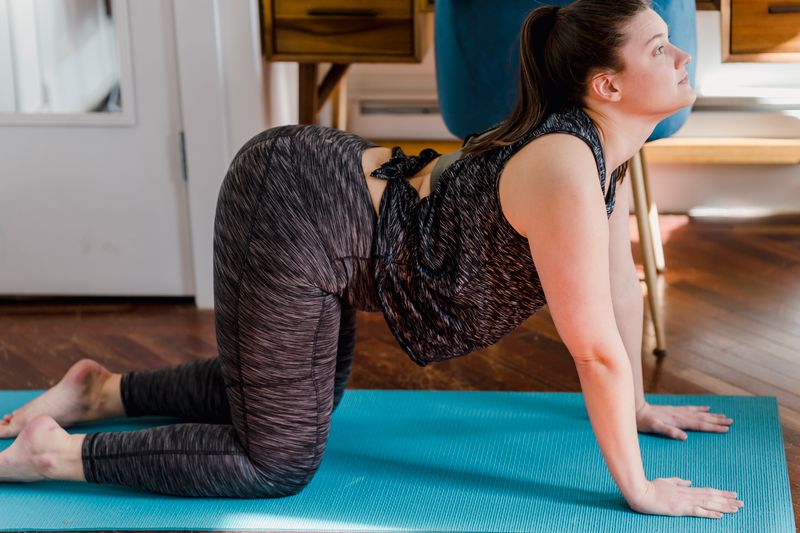
Full Routine — approximately 17-18 minutes
- Centering Breath — 1 min (seated or lying, slow nasal breathing, no stretching yet)
- Cat-Cow — 1 min (10 slow reps)
- Child's Pose — 1 min
- Thread the Needle — 45 sec each side
- Kneeling Hip Flexor Stretch — 45 sec each side
- Standing or Seated Hamstring Stretch — 45 sec each side
- Figure-4 Glute Stretch (seated or lying) — 45 sec each side
- Standing Quad Stretch — 45 sec each side
- Calf Stretch — 45 sec each side
- Seated Spinal Twist — 45 sec each side
- Doorway Chest/Shoulder Stretch — 45 sec each side
- Gentle Neck Stretch, side to side — 30 sec each side
- Final Child's Pose or lying rest — 2 min
Tracker coming next
We're building a dedicated tracker for this standalone recovery routine — session frequency, which areas feel tight, and range-of-motion self-checks over time.
FormForge content is for educational purposes only and is not medical advice. This routine is not a treatment for injuries. If you are recovering from an injury or experiencing pain, consult a qualified physiotherapist or physician before beginning any stretching programme — do not use this routine as a substitute for professional care. Stop immediately if you feel sharp or worsening pain. As an Amazon Associate, FormForge earns from qualifying purchases. Amazon Associate tag: everydaytop03-21.
Comments
Post a Comment